



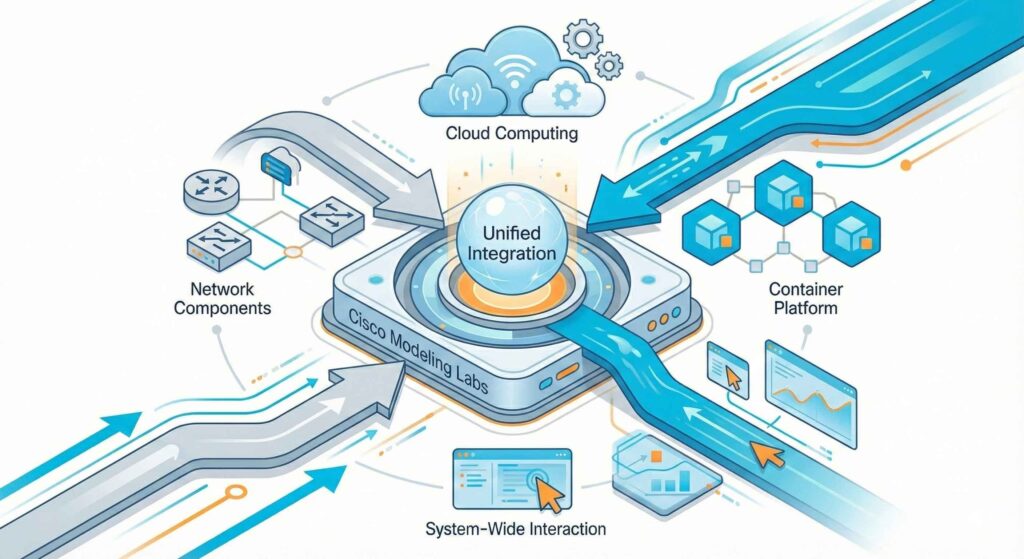
Container nodes in Cisco Modeling Labs (CML) 2.9 complement digital machines, providing larger flexibility and effectivity. Engineers profit from having light-weight, programmable, and quickly deployable choices inside their simulation environments. Whereas digital machines (VMs) dominate with community working methods, containers add flexibility, enabling instruments, visitors injectors, automation, and full functions to run easily along with your CML topology. Conventional digital machines are nonetheless efficient, however customized containers introduce a transformative agility.
Constructing photographs that behave predictably and combine cleanly with simulated networks is way simpler with containers. As anybody who has tried to drop a inventory Docker picture into CML shortly discovers, this isn’t an easy course of. Typical Docker photographs lack the required CML-compatible metadata, community interface behaviors, and lifecycle properties. Utilizing containers with CML is the lacking ingredient.
This weblog submit gives a sensible, engineering-first walkthrough for constructing containers which can be actually CML-ready.
Word about enhancements to CML: When containers had been launched, just one picture per node definition was allowed. With the CML 2.10 launch, this restriction has been lifted. Particularly, the next enhancements can be added:
- Per picture definition, Docker tag names similar to:
debian:bookworm, debian:buster and debian:trixie
Are all legitimate tags for a similar “debian-docker” node definitions—three legitimate picture definitions for one node definition.
- Specification of Docker tags as a substitute for picture names (.tar.gz information) and SHA256 has sums. On this case, CML will attempt to obtain the picture from a container registry, e.g., Docker Hub, if not in any other case specified.
- Improved launch logic to keep away from “perpetual launches” in case the SHA256 sum from the picture definition didn’t match the precise hash sum within the picture.
Why do customized containers in CML matter?
Conventional CML workflows depend on VM-based nodes operating IOSv, IOS-XRv, NX-OS, Ubuntu, Alpine, and different working methods. These are glorious for modeling community working system habits, however they’re heavyweight for duties similar to integrating CLI instruments, internet browsers, ephemeral controllers, containerized apps, microservices, and testing harnesses into your simulations.
Containers begin shortly, devour fewer assets, and combine easily with normal NetDevOps CI/CD workflows. Regardless of their benefits, integrating normal Docker photographs into CML isn’t with out its challenges, every of which requires a tailor-made resolution for seamless performance.
The hidden challenges: why a Docker picture isn’t sufficient
CML doesn’t run containers in the identical means a vanilla Docker Engine does. As an alternative, it wraps containers in a specialised runtime setting that integrates with its simulation engine. This results in a number of potential pitfalls:
- Entry factors and init methods
Many base photographs assume they’re the solely course of operating. In CML, community interfaces, startup scripts, and boot readiness must be supplied. Additionally, CML expects a long-running foreground course of. In case your container exits instantly, CML will deal with the node as “failed.” - Interface mapping
Containers typically use eth0, but CML attaches interfaces sequentially based mostly on topology (eth0, eth1, eth2…). Your picture ought to deal with further interfaces added at startup, mapping them to particular OS configurations. - Capabilities and customers
Some containers drop privileges by default. CML’s bootstrap course of may have particular entry privileges to configure networking or begin daemons. - Filesystem format
CML makes use of non-compulsory bootstrap belongings injected into the container’s filesystem. A typical Docker picture received’t have the correct directories, binaries, or permissions for this. If wanted, CML can “inject” a full suite of command-line binaries (“busybox”) right into a container to offer a correct CLI setting. - Lifecycle expectations
Containers ought to output log data to the console in order that performance will be noticed in CML. For instance, an online server ought to present the entry log.
Misalign any of those, and also you’ll spend hours troubleshooting what seems to be a easy “it really works with run” situation.
How CML treats containers: A psychological mannequin for engineers
CML’s container capabilities revolve round a node-definition YAML file that describes:
- The picture to load or pull
- The bootstrap course of
- Atmosphere variables
- Interfaces and the way they bind
- Simulation habits (startup order, CPU/reminiscence, logging)
- UI metadata
When a lab launches, CML:
- Deploys a container node
- Pulls or masses the container picture
- Applies networking definitions
- Injects metadata, IP deal with, and bootstrap scripts
- Displays node well being through logs and runtime state
Consider CML as “Docker-with-constraints-plus-network-injection.” Understanding CML’s strategy to containers is foundational, however constructing them requires specifics—listed here are sensible suggestions to make sure your containers are CML-ready.
Suggestions for constructing a CML-ready container
The container photographs constructed for CML 2.10 and ahead are created on GitHub. We use a GitHub Motion CI workflow to totally automate the construct course of. You possibly can, in truth, use the identical workflow to construct your individual customized photographs able to be deployed in CML. There’s loads of documentation and examples that you may construct off of, supplied within the repository* and on the Deep Wiki.**
Essential word: CML treats every node in a topology as a single, self-contained service or software. Whereas it may be tempting to immediately deploy multi-container functions, typically outlined utilizing docker-compose , into CML by trying to separate them into particular person CML nodes, this strategy is usually not beneficial and might result in important issues.
1.) Select the correct base
Begin from an already current container definition, like:
- nginx (single-purpose community daemon utilizing a vanilla upstream picture).
- Firefox (graphical person interface, customized construct course of).
- Or a customized CI-built base along with your normal automation framework.
Keep away from utilizing photographs that depend on SystemD except you explicitly configure it; SystemD inside containers will be tough.
2.) Outline a correct entry level
Your container should:
- Run a long-lived course of.
- Not daemonize within the background.
- Help predictable logging.
- Maintain the container “alive” for CML.
Right here’s a easy supervisor script:
#!bin/sh

echo "Container beginning..."

tail  -f /dev/null
Not glamorous, however efficient. You possibly can substitute tail -f /dev/null along with your service startup chain.
3.) Put together for a number of interfaces
CML might connect a number of interfaces to your topology. CML will run a DHCP course of on the primary interface, however except that first interface is L2-adjacent to an exterior connector in NAT mode, there’s NO assure it should purchase one! If it can’t purchase an IP deal with, it’s the lab admin’s accountability to offer IP deal with configuration per the day 0 configuration. Usually, ip config … instructions can be utilized for this goal.
Superior use circumstances you possibly can unlock
When you conquer customized containers, CML turns into dramatically extra versatile. Some well-liked use circumstances amongst superior NetDevOps and SRE groups embrace:
Artificial visitors and testing
Automation engines
- Nornir nodes
- pyATS/Genie take a look at harness containers
- Ansible automation controllers
Distributed functions
- Fundamental service-mesh experiments
- API gateways and proxies
- Container-based middleboxes
Safety instruments
- Honeypots
- IDS/IPS parts
- Packet inspection frameworks
Deal with CML as a “full-stack lab,” enhancing its capabilities past a mere community simulator.
Make CML your individual lab
Creating customized containers for CML turns the platform from a simulation device into a whole, programmable take a look at setting. Whether or not you’re validating automation workflows, modeling distributed methods, prototyping community features, or just constructing light-weight utilities, containerized nodes mean you can adapt CML to your engineering wants—not the opposite means round.
If you happen to’re prepared to increase your CML lab, the easiest way to begin is easy: construct a small container, copy and modify an current node definition, and drop it right into a two-node topology. When you see how easily it really works, you’ll shortly notice simply how far you possibly can push this function.
Would you prefer to make your individual customized container for CML? Tell us within the feedback!
* Github Repository – Automation for constructing CML Docker Containers
** DeepWiki – CML Docker Containers (CML 2.9+)
Join Cisco U. | Be a part of the Cisco Studying Community at present free of charge.
Comply with Study with Cisco
X | Threads | Fb | LinkedIn | Instagram | YouTube
Use #CiscoU and #CiscoCert to affix the dialog.
