



The crimson carpet, in the event you can imagine it, was as soon as a trend useless zone, a sequin-strewn wasteland the place good style went to die. For years, many stars served as their very own stylist or whipped up their very own garments, with predictably patchy outcomes. In 1989, when Demi Moore confirmed as much as the Academy Awards in a spandex-bike-shorts-and-corset ensemble of her personal design, Girls’s Put on Each day known as it an “Oscar Fright.”
However earlier this 12 months, Moore dominated awards-season best-dressed lists, successful raves for a sublime, metallic Oscars robe with a plunging neckline and a skirt that swept to the ground, pooling in a shimmering puddle. The costume was the work of the Italian designer Giorgio Armani, who died yesterday in Milan on the age of 91—and who was the rationale so many stars put on excessive trend within the first place. Throughout his 50-year solo profession, the designer remodeled the crimson carpet right into a runway, educating Hollywood tips on how to costume and harnessing the facility of movie star to construct his international trend empire—and his legacy.
As a younger man, Armani studied drugs and served within the army. He obtained his begin within the trend {industry} “nearly by chance,” he advised Time in 1982, by taking a job on the high-end Milanese division retailer La Rinascente. There, he discovered about material and buyer conduct, and his expertise ultimately led him to a job with the Italian designer Nino Cerruti. A relationship with Sergio Galeotti, an architect, helped Armani strike out on his personal; though Armani valued the steadiness of a salaried job, Galeotti inspired him to create designs below his personal title. In 1975, the 2 of them based the Armani label in Milan.
From his earliest days working in Italy, the designer excelled in each menswear and girls’s clothes—an uncommon feat—and androgyny was an indicator of his work. He was identified for fits, and although they had been usually labeled “energy fits,” they had been the antithesis of high-finance stuffiness. Free and drapey, they evoked the Italian Renaissance ideally suited of sprezzatura, or “easy class,” and each women and men had been seduced by them. Armani helped make pantsuits stylish for girls at a time after they had been simply turning into broadly accepted as officewear and eveningwear.
His relationship with Hollywood took off within the Nineteen Eighties. On the time, the crimson carpet was a web site of chaos. Below the Hollywood studio system that had managed the movie {industry} because the late Twenties, in-house wardrobe departments usually served as each designers and stylists, dressing every studio’s steady of actors for premieres and events. That system collapsed within the Nineteen Sixties, liberating actors to decide on their very own initiatives and collaborators however leaving them sartorially adrift. Though some stars had long-standing relationships with A-list trend designers—Audrey Hepburn with Givenchy, Liza Minnelli with Halston—others turned to the Vegas-style glitz of homegrown Hollywood dressmakers reminiscent of Bob Mackie and Nolan Miller, or made their very own garments, as Moore did. The scenario grew so dire that at one level, the Oscars telecast offered Academy-approved robes and tuxedos free to presenters. Because the present’s costume designer, Ron Talsky, defined to the Each day Information in 1984, attendees “could be supplied solutions on what to put on, however they only confirmed up and no one actually cared how they appeared.”
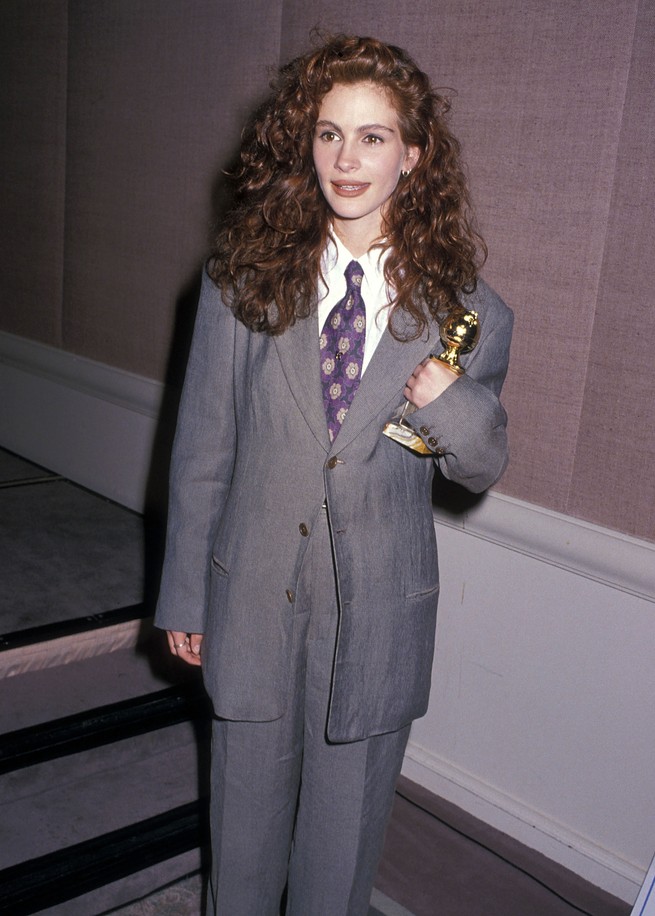
Ron Galella / Getty
Julia Roberts attends the forty seventh annual Golden Globe Awards on January 20, 1990.
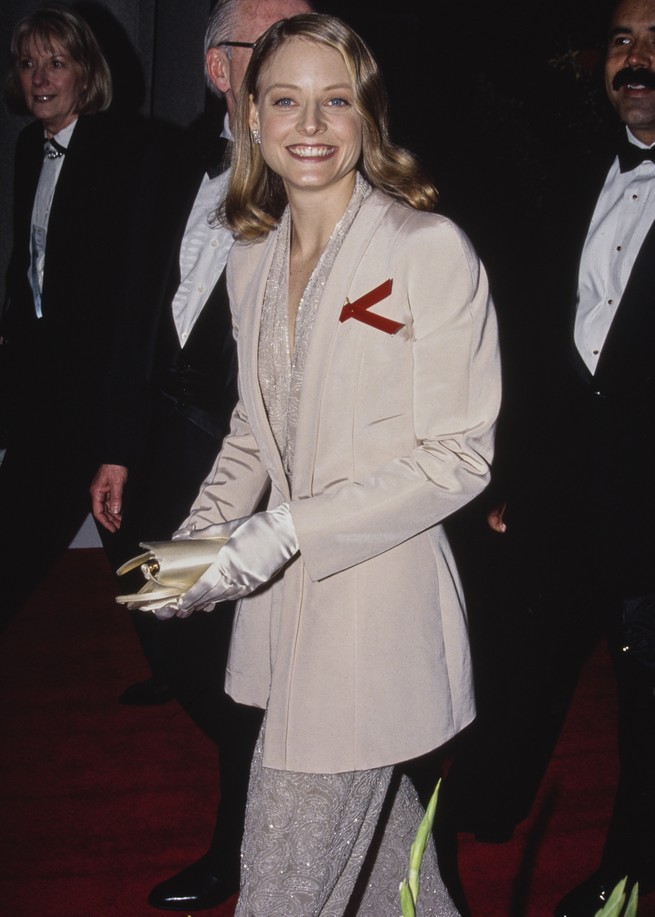
Vinnie Zuffante / Getty
Jodie Foster attends the sixty fourth annual Academy Awards in Los Angeles on March 30, 1992.
But Armani noticed a chance: He believed that he may win over American prospects via the leisure {industry}. Diane Keaton was an early adopter of his designs and in 1978 wore certainly one of his jackets whereas accepting her Oscar for Annie Corridor. Simply a few years later, his profile exploded. He had jumped on the probability to decorate Richard Gere’s posh hustler within the 1980 movie American Gigolo, and in Armani’s slouchy, horny, unstructured fits, Gere “did extra for the reason for males’s fashions than any spiffy dresser since Cary Grant,” a trend editor on the Chicago Solar-Instances gushed on the time. (The understated seems to be served as harbingers of right now’s stealth wealth and quiet luxurious.) Armani’s gross sales soared, and the designer went on to create menswear for a lot of films and TV exhibits, together with Miami Vice, The Untouchables, The Darkish Knight, The Wolf of Wall Road, and The Social Community.
In 1988, Armani opened a palatial 13,000-square-foot boutique on Rodeo Drive, making a daring declare to his self-appointed place as Hollywood’s resident couturier. He put in a VIP showroom and employed a “director of entertainment-industry communications” to function a liaison between the boutique and the crimson carpet. He took delight in not paying celebrities for entry, however he didn’t hesitate to supply his most popular purchasers free or discounted garments and all-expenses-paid journeys to Milan to take a seat within the entrance row at his exhibits.
This was the opening salvo in a red-carpet arms race. Different designers rapidly imitated Armani’s ways, however he was already an honorary member of the Hollywood elite. Julia Roberts wore an oversize menswear-inspired go well with (full with tie) to the 1990 Golden Globes, and Jodie Foster accepted her 1992 Oscar for The Silence of the Lambs in a pale-pink Armani go well with with refined silver beading. His clothes turned equally widespread with Hollywood brokers and energy brokers, such because the director Martin Scorsese, the producer Don Simpson, the Columbia Photos president Daybreak Metal, and the dapper NBA coach Pat Riley. Armani’s relaxed silhouettes and light-weight Italian wools, crepes, and cashmeres labored as properly in Los Angeles as they did in Milan. In 1990, Girls’s Put on Each day declared the Academy Awards the “Armani Awards.” Because the designer had predicted, by conquering Hollywood, he had conquered America.
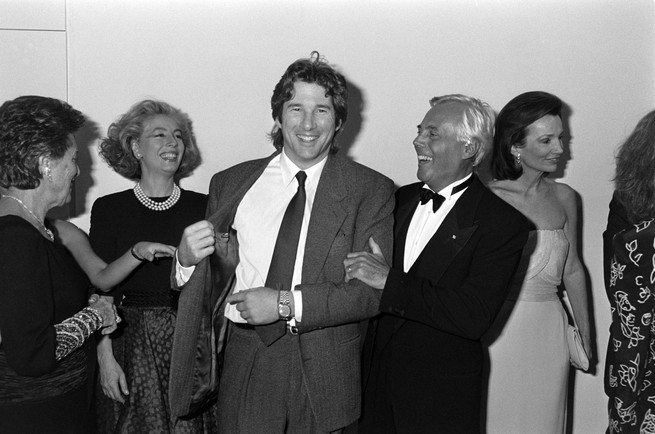
Artwork Streiber / WWD / Penske Media by way of Getty
The actor Richard Gere exhibits the designer Giorgio Armani his go well with label, as company watch the alternate, with the socialite Lee Radziwill.
Over time, nevertheless, not everybody has applauded the modifications that Armani ushered into Hollywood. Rita Watnick, the proprietor of the celeb-friendly Los Angeles vintage-clothing boutique Lily et Cie, didn’t like that ladies had been carrying pants to the Oscars; she blamed Armani for dressing down Hollywood. In 1999, after extra designers had established relationships with celebrities and Oscar seems to be had develop into extra uniformly tasteful, Anna Wintour recommended that the occasion’s trend had additionally develop into boring, writing in Vogue, “It was sufficient to make you yearn for the memorable trend fake pas of years previous, or a minimum of a star safe sufficient to forgo designers and stylists and dare to precise herself.”
Armani, for his half, remained steadfast in his selections, and insisted that he maintained values of class in his work it doesn’t matter what modified round him. On the similar time, he appeared to welcome the concept that what occurred on the crimson carpet would possibly change once more. In 2018, throughout the peak of the #MeToo protests, when some stars turned clothes right into a type of solidarity—rows and rows of them dressing in all black on the Golden Globes—he appeared to marvel at simply how highly effective a logo that trend on the crimson carpet had develop into. However he additionally famous that he didn’t suppose it was essentially shocking. “The crimson carpet,” he wrote in The Guardian, “was all the time a chance for growing new concepts and thus for progress.”
