



By JASON HINES
On August 1, 2025, Capital Girls’s Care (CWC), one of many largest OB/GYN practices within the Mid-Atlantic area went out-of-network with UnitedHealthcare, affecting tens of 1000’s of ladies throughout Maryland, Virginia, Pennsylvania, and Washington D.C. The contract dispute between Capital Girls’s Care (CWC) and UnitedHealthcare provides an interesting case research in how worth transparency information can illuminate the true dynamics behind these high-stakes negotiations.
The Public Battle
Capital Girls’s Care, with greater than 250 physicians and healthcare professionals, confirmed that its settlement with UnitedHealthcare would lapse regardless of ongoing negotiations. The follow urged sufferers to contact UHC to voice their considerations about dropping entry to their suppliers.
UnitedHealthcare fired again with detailed public claims on their web site, alleging that CWC “refused to maneuver off its calls for for double-digit worth hikes” and is “considerably increased price at this time in comparison with peer suppliers all through Maryland and Virginia”. UHC supplied particular examples, claiming {that a} vaginal supply from CWC would price “greater than 120% increased – or over $2,600 extra – than the typical price of different OB/GYN suppliers”.
However what does the precise worth transparency information reveal about these competing claims?
What the Transparency Knowledge Exhibits
Utilizing Capital Girls’s Care’s negotiated charges from UnitedHealthcare’s personal machine-readable recordsdata, we analyzed a pattern of widespread OB/GYN procedures from Maryland price information. Whereas this represents solely a subset of all procedures and focuses particularly on Maryland charges, it offers invaluable insights into the true fee dynamics between these organizations. The info paints a extra nuanced image than both occasion’s public statements counsel.
Knowledge Methodology Observe: Our evaluation examined negotiated charges for Capital Girls’s Care from publicly obtainable machine-readable recordsdata, specializing in Maryland suppliers and filtering out statistical outliers (charges beneath 50% or above 500% of Medicare). We analyzed charges for each UnitedHealthcare and CareFirst throughout three widespread OB/GYN procedures the place each payers had adequate information.
CWC’s Fee Place vs Different Payers
Our evaluation of three widespread OB/GYN procedures in Maryland reveals that CWC’s charges with UnitedHealthcare had been truly fairly aggressive in comparison with different main payers:
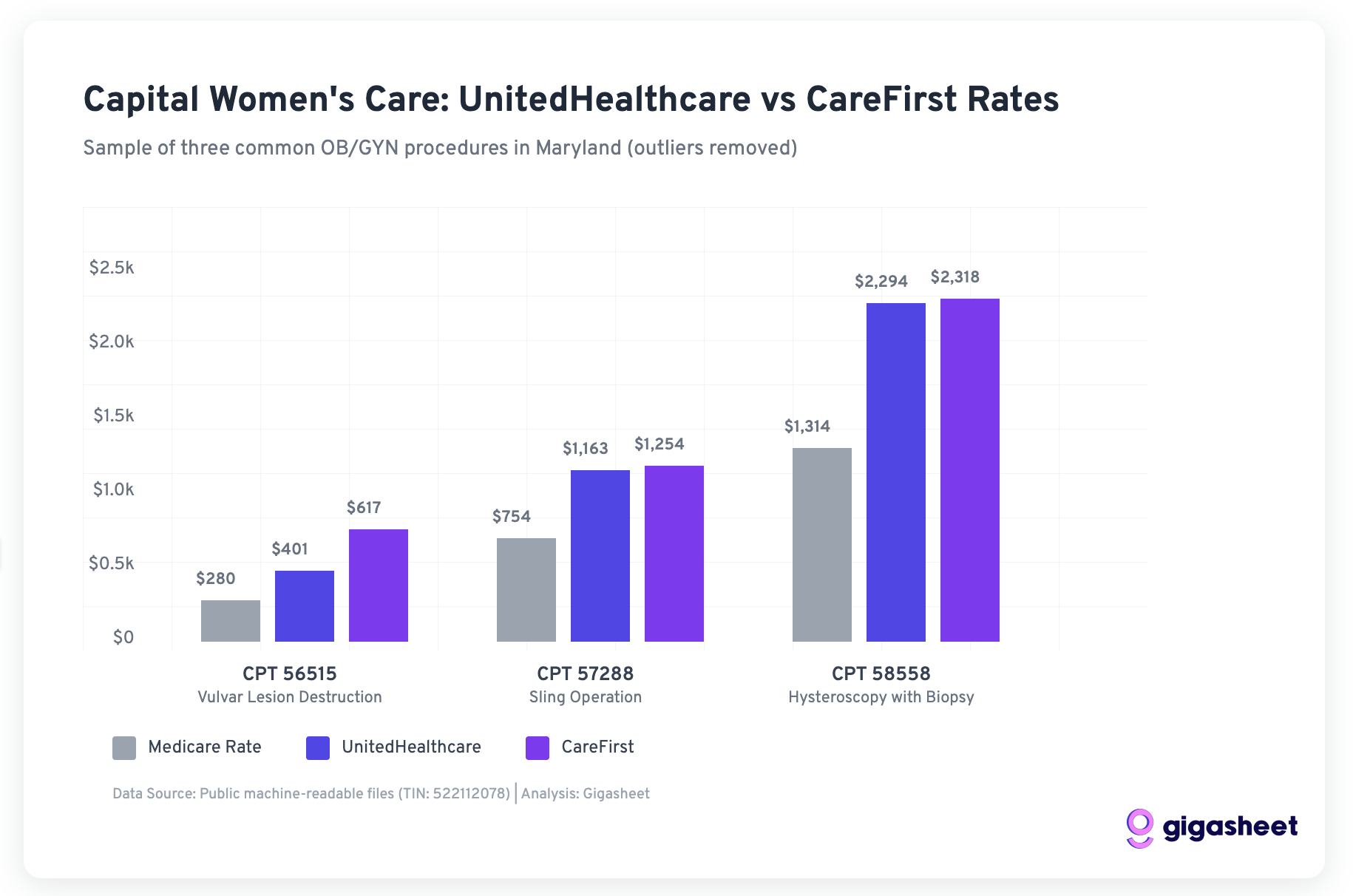
For the three procedures the place each UHC and CareFirst have negotiated charges with CWC:
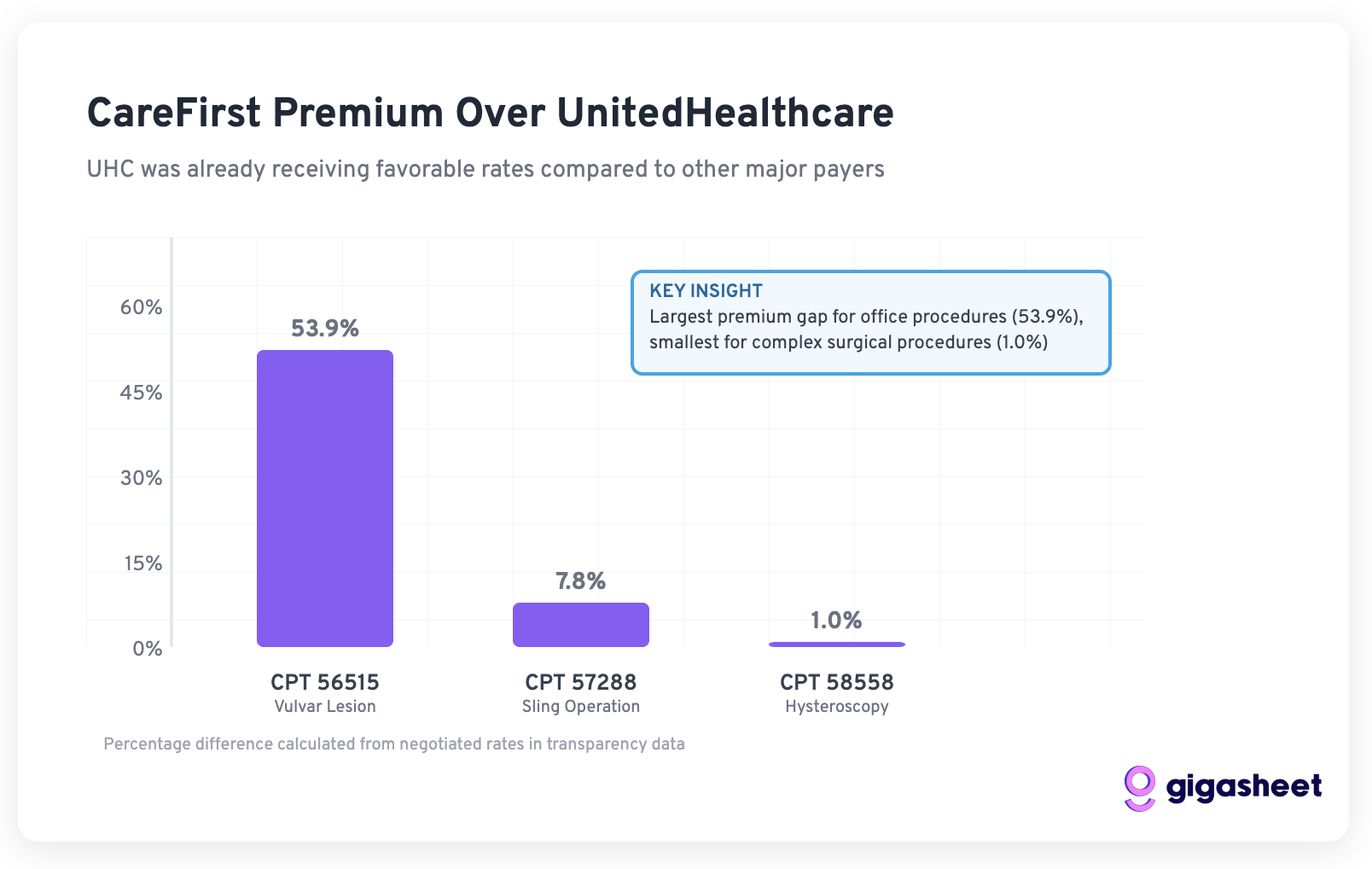
- CPT 56515 (Vulvar Lesion Destruction): UHC paid $401 vs CareFirst’s $617 (53.9% distinction)
- CPT 57288 (Sling Operation): UHC paid $1,163 vs CareFirst’s $1,254 (7.8% distinction)
- CPT 58558 (Hysteroscopy): UHC paid $2,294 vs CareFirst’s $2,318 (1.0% distinction)
This pattern information suggests UnitedHealthcare was already getting favorable charges from CWC in comparison with different main payers, calling into query UHC’s claims about CWC being “considerably increased price.”
The Medicare Benchmark Actuality
Each UHC and CareFirst had been paying CWC charges properly above Medicare in our pattern:
- UnitedHealthcare: 143-175% of Medicare charges
- CareFirst: 166-220% of Medicare charges
Whereas CareFirst paid increased charges, UnitedHealthcare’s charges had been nonetheless substantial premiums over authorities reimbursement, suggesting the “double-digit will increase” CWC requested could have been makes an attempt to align with market charges different payers had been keen to pay.
Essential Limitation: This evaluation is predicated on a pattern of three procedures in Maryland solely. A complete evaluation would require inspecting all process codes throughout all markets the place CWC operates to completely validate these patterns.
The Strategic Context: Market Share Issues
Understanding why CWC may need walked away requires inspecting UnitedHealthcare’s place within the Maryland market. Based on KFF information, UnitedHealthcare holds solely 9% of Maryland’s giant group market share as of 2023. This comparatively small market place gave CWC important leverage.
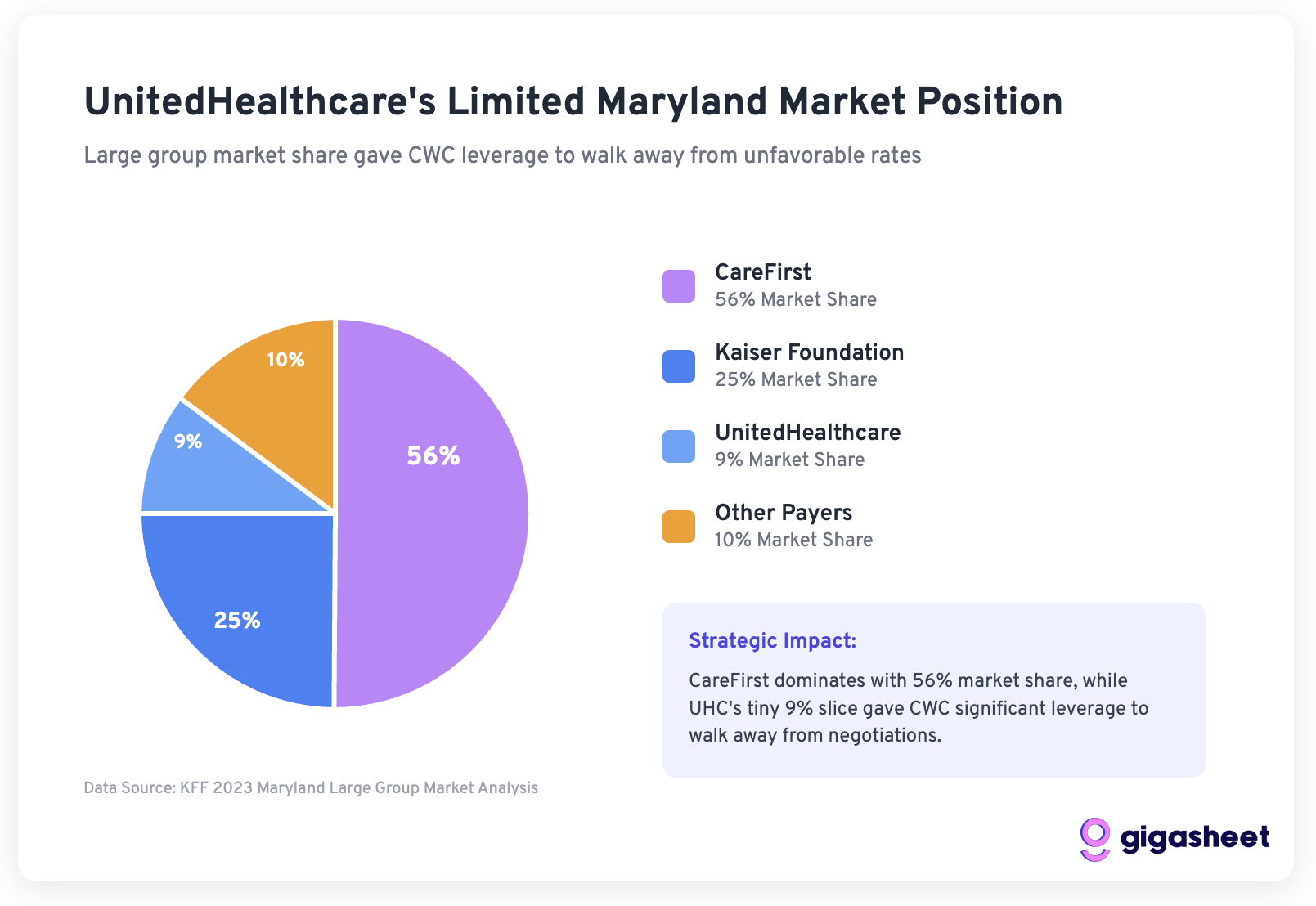
The Math of Strolling Away:
- UHC represents a small portion of CWC’s affected person base
- CWC has contracts with bigger payers (Aetna, CareFirst, Cigna) paying increased charges
- The follow serves over 250 suppliers throughout a number of states
- Strolling away from 9% of the market to determine price precedent makes strategic sense
Evaluating UnitedHealthcare’s Public Claims
UHC’s web site makes a number of particular claims that we will consider towards transparency information:
Declare 1: “CWC is considerably increased price in comparison with peer suppliers”
Evaluation: Partially Deceptive
Whereas CWC could cost greater than some suppliers, our evaluation exhibits UHC was paying aggressive charges in comparison with different main payers for a similar providers. The “peer supplier” comparability lacks context about geographic market charges and supplier high quality variations.
Declare 2: “Double-digit worth hikes that might make them 30% increased than common”
Evaluation: Lacking Context
This declare doesn’t account for:
- How UHC’s present charges in comparison with different payers
- Whether or not the “common” consists of lower-quality or in a different way positioned suppliers
- Regional price variations within the costly Mid-Atlantic market
Declare 3: Particular process price comparisons
Evaluation: Probably Correct however Incomplete
UHC’s claims about supply prices could also be correct, however they don’t present the total market context. The transparency information exhibits important price variation throughout payers and procedures, suggesting that “costly” is relative to the comparability set chosen.
How Value Transparency Modifications the Recreation
This dispute illustrates how worth transparency information is reshaping healthcare negotiations in a number of methods:
Knowledgeable Leverage
Suppliers like CWC can now see precisely how their charges examine throughout payers, enabling extra strategic negotiations. CWC knew they had been giving UHC favorable charges in comparison with CareFirst.
Public Accountability
Each events made public claims that may now be fact-checked towards precise negotiated charges. UHC’s claims about CWC being “considerably increased price” are extra nuanced when considered towards the total payer panorama.
Market Benchmarking
The transparency information reveals that:
- Regional markets have substantial price variations
- Supplier high quality and market place justify price premiums
- “Costly” is relative to the comparability being made
Strategic Positioning
For a follow with CWC’s market place, sustaining price self-discipline throughout payers turns into essential. Accepting below-market charges from one payer can undermine negotiations with others.
The Actual Winner: Market Transparency
Whereas sufferers are caught in the midst of this dispute, the broader healthcare market advantages from the transparency this battle offers. The general public availability of precise negotiated charges means:
- Sufferers could make extra knowledgeable selections about suppliers and plans
- Employers can higher consider insurance coverage plan worth propositions
- Suppliers can benchmark their charges towards precise market information
- Payers should justify price choices with actual information quite than selective comparisons
Wanting Ahead: Classes for Healthcare Negotiations
The CWC-UHC dispute provides a number of classes for future healthcare contract negotiations:
- Value transparency information is now a negotiating instrument – Either side can and can use precise price comparisons to help their positions
- Market share issues in price negotiations – UHC’s 9% Maryland market share restricted their leverage towards a big, established supplier
- Public relations battles require information backing – Claims about “costly” suppliers can now be fact-checked towards precise negotiated charges
- Supplier consolidation creates negotiating energy – Giant practices like CWC can afford to stroll away from unfavorable contracts
The Path to Decision
For this particular dispute, the transparency information suggests each events have cheap positions:
- CWC was certainly giving UHC favorable charges in comparison with different payers, justifying their request for will increase
- UHC faces stress to regulate prices for members whereas sustaining an satisfactory supplier community
A decision probably requires:
- UHC acknowledging that their present charges had been beneath market
- CWC accepting that dramatic price will increase have an effect on affected person prices
- Each events discovering center floor that displays true market positioning
The provision of precise negotiated price information ought to, in concept, make these conversations extra productive by establishing shared info about market charges and supplier positioning.
Conclusion
The Capital Girls’s Care vs UnitedHealthcare contract dispute demonstrates how worth transparency is essentially altering healthcare negotiations. Whereas each events made public claims supporting their positions, our evaluation of precise negotiated price information from Maryland reveals a extra complicated story the place market dynamics, strategic positioning, and regional elements all play essential roles.
Key takeaways from our information evaluation:
- UHC was paying aggressive charges in comparison with different main payers for the procedures we examined
- CWC’s choice to stroll away makes strategic sense given UHC’s restricted 9% Maryland market share
- Each payers had been paying properly above Medicare charges, suggesting room for negotiation
Essential caveats: Our evaluation examined solely three widespread procedures from Maryland information. A complete analysis would require analyzing all process codes throughout all markets the place CWC operates to completely validate these patterns.
As extra stakeholders acquire entry to this beforehand hidden pricing info, we will count on healthcare contract negotiations to develop into extra data-driven, clear, and finally extra rational. The true winners will probably be those that can successfully analyze and act on this new transparency to make higher choices about healthcare protection, supplier choice, and contract phrases.
I’ll be again on THCB to have a look at the remainder of the context for this dispute partly 2. What was the price of these providers from different suppliers out there?
Jason Hines is CEO of Gigasheet which delivers AI-powered worth transparency market intelligence.. This was first posted on their company weblog
