


TL;DR: The tales you inform your self typically develop into the beliefs that form your actions, relationships, and resilience. The excellent news? Beliefs aren’t fastened. By recognizing limiting beliefs and training easy workouts to problem them, you possibly can construct a more healthy mindset and reply to life’s challenges with larger confidence.
On daily basis, your mind tells 1000’s of tiny tales.
“I’m not good at shows.”
“Nothing I do makes a distinction.”
“This week goes to be a catastrophe.”
These ideas could appear to be passing commentary, however your mind is paying nearer consideration than you suppose.
The tales you repeat to your self typically develop into beliefs. And people beliefs quietly form the way you reply to challenges, construct relationships, deal with setbacks, and even resolve whether or not one thing is value making an attempt within the first place.
That’s the concept behind The Energy of Beliefs, a brand new e-book by optimistic psychology researcher Shawn Achor. In a current dialog with Mark Williamson of Motion for Happiness, Achor shared the science behind why our beliefs matter a lot — and, extra importantly, how we will change those which are holding us again.
Right here’s what the analysis says and some easy methods to place it into observe at work and at residence.
What Is “The Energy of Perception,” Actually?
When most individuals hear the phrase “perception,” they consider one thing fuzzy: an opinion, a hope, a matter of private outlook. However in line with Achor’s analysis, beliefs operate extra like predictions. They’re the hypotheses your mind runs about what’s prone to occur subsequent, and people predictions form the actions you truly take.
That distinction issues as a result of it means beliefs aren’t simply “good to have” for morale. They’ve measurable, bodily results.
Contemplate the proof:
- Each new drug that goes via medical trials is measured towards a placebo, and the placebo impact itself has gotten stronger over the previous 20 years, not weaker.
- A 2002 examine on knee surgical procedure break up members into two teams. Two-thirds obtained an actual surgical process. The remaining third obtained anesthesia and an incision, however no precise process. On the 18-month mark, therapeutic charges, mobility, and ache ranges had been almost an identical between each teams.
- Athletes acting at residence sometimes take pleasure in a “residence discipline benefit,” and researchers discovered that benefit disappeared virtually solely throughout COVID when stadiums sat empty. The one variable that modified was whether or not gamers believed a crowd was behind them.
None of this implies optimistic considering cures sickness or wins video games by itself. It means perception is doing actual, physiological work that almost all of us underestimate, and that work reveals up within the office, too.
Why Perception Belongs in Your Wellness Technique
Health packages, diet help, and stress administration assets matter. However an worker may be well-rested, well-fed, and nonetheless be working from a perception that quietly undercuts all of it: that their work does not matter, that they are on their very own, or that nothing they do will change the result.
Here is why that issues for employers particularly:
- It is predictive. Analysis reveals that altering a single core perception, whereas holding each different circumstance fixed, can considerably shift outcomes like educational efficiency, restoration charges, and even survival odds in severe sickness.
- It is cultural. Groups that share a way of shared goal and mutual belief construct resilience that particular person perks cannot replicate.
- It is typically invisible. In contrast to a missed exercise or a skipped lunch break, an unhelpful perception does not present up on a dashboard. It reveals up in disengagement, burnout, and turnover as an alternative.
Some eye-opening context from the analysis:
- Charges of burnout, anxiousness, loneliness, and melancholy have roughly doubled over the previous 15 years, throughout nearly all ages group.
- Solely 16% of employees say they need to keep in the identical job subsequent yr that they’ve this yr, the bottom quantity Gallup has ever recorded.
- American males over 30 report 60% much less face-to-face social interplay than they’d simply 20 years in the past.
Luckily, beliefs aren’t set in stone. They will shift, typically quicker than individuals anticipate.
The 7 Beliefs Behind Burnout
Achor’s analysis identifies seven core beliefs that present up time and again in individuals experiencing burnout, anxiousness, loneliness, and melancholy:
- My habits does not matter
- I am alone
- I do not matter
- My work is not significant
- I’ve nothing to present
- I am lacking out
- There’s nothing larger than me
If one or two of these really feel acquainted, you are not alone (no pun supposed). The encouraging half is that the alternative of every perception is simply as highly effective. Workers who imagine their contributions matter, that they are related to one thing greater, and that they’ve one thing to supply have a tendency to indicate up in another way at work, not as a result of they’re forcing optimism, however as a result of their mind is working from a distinct set of predictions about what’s potential.
The best way to Truly Shift a Perception: 2 Sensible Methods
Speaking about beliefs is one factor. Altering them is one other. Achor’s analysis factors to 2 methods which are easy sufficient to make use of beginning as we speak, whether or not you are a supervisor, an HR chief, or simply having a tough week your self.
1. Add a Qualifier and a Warrant
Telling somebody “you have acquired this” is a pleasant sentiment, however by itself, it does not give the mind something to behave on. Achor calls the lacking items the “warrant” (the as a result of) and the “qualifier” (the if-then).
Evaluate these two statements:
- “You are going to do nice at this presentation.”
- “You are going to do nice at this presentation as a result of you have dealt with powerful audiences earlier than, if you retain prepping the best way you’ve gotten been.”
The second model offers the mind proof and a path ahead. Strive swapping in a as a result of and an if the following time you are encouraging a direct report, a teammate, or your self.
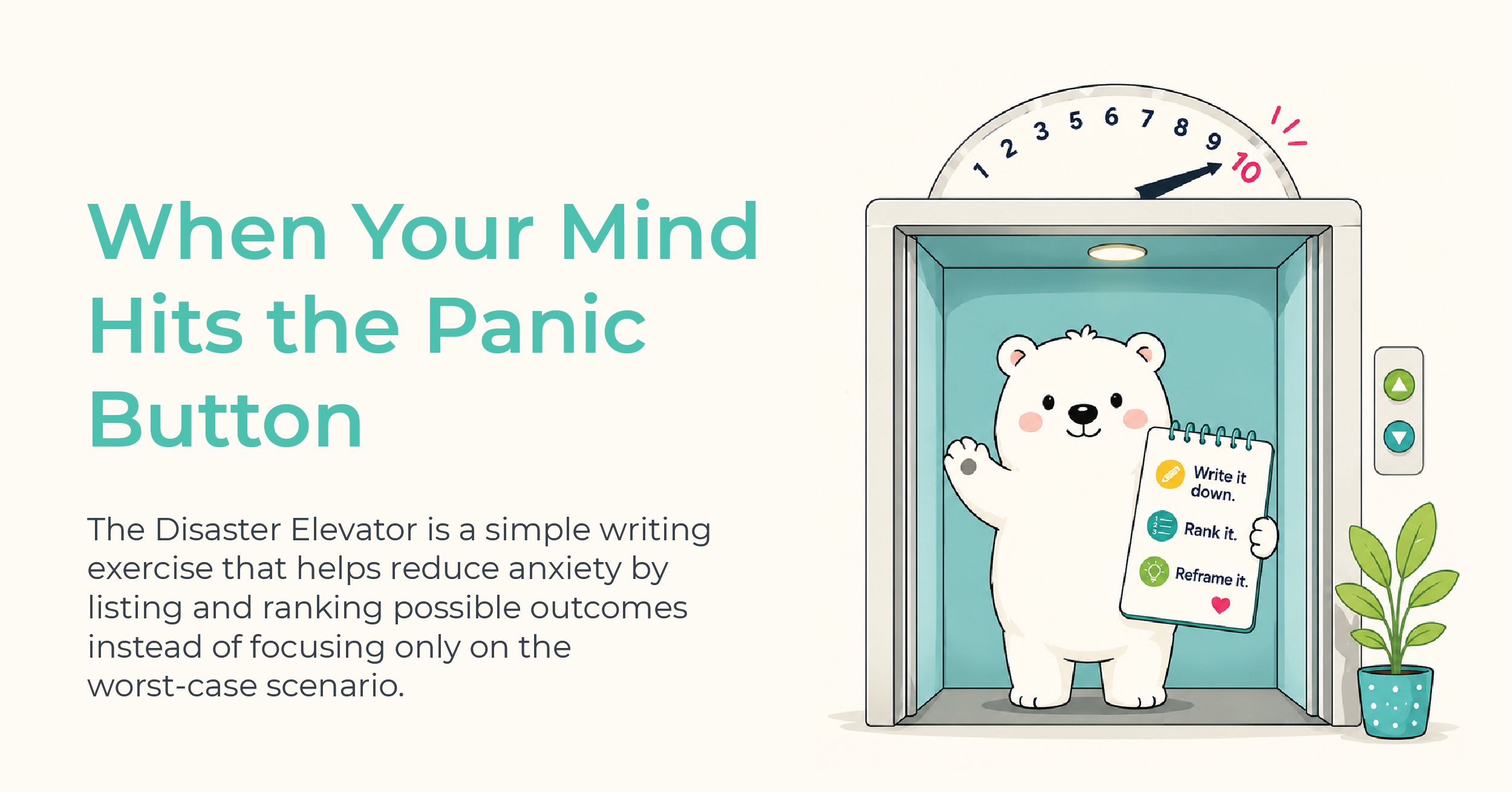
2. Strive the “Catastrophe Elevator”
When anxiousness fixates on one worst-case final result, Achor suggests writing down ten potential outcomes, ranked from worst to least dangerous, as an alternative of spiraling on a single situation.
The train works as a result of rating a number of outcomes shifts mind exercise away from the amygdala (which drives emotional overwhelm) towards the prefrontal cortex (which handles decision-making and planning). Workers typically understand partway via the listing that they hadn’t thought-about any of the extra impartial, and even optimistic, outcomes in any respect.
Associated: Need extra research-backed methods to construct resilience in your staff? Take a look at our information on office stress administration methods.
Frequent Questions About Perception and Wellbeing
Q: Is not specializing in “perception” simply one other means of selling poisonous positivity?
A: Achor pushes again on this instantly. He argues the true downside is not positivity, it is ignorance of the true challenges individuals face. The aim is not to faux issues do not exist. It is to acknowledge what’s genuinely tough whereas refusing to let one perception (like “nothing I do issues”) write the entire story.
Q: Can altering a perception actually have an effect on bodily outcomes?
A: In accordance with the analysis cited in The Energy of Beliefs, sure. Research on situations starting from power ache to childhood epilepsy to most cancers restoration present that shifting a single perception, whereas holding each different variable fixed, can meaningfully change outcomes. Whereas beliefs aren’t an alternative choice to medical care, they’ll affect stress ranges, resilience, remedy adherence, and general well-being.
Q: How can employers help this with out it feeling compelled or synthetic?
A: Begin small. Encourage managers to make use of qualifiers and warrants when giving suggestions. Construct in common alternatives for workers to replicate on significant moments (a fast weekly immediate works effectively). Normalize speaking about setbacks truthfully reasonably than glossing over them. Genuine, low-pressure practices are inclined to land higher than a mandated “positivity initiative.”
Bringing Perception Into Your Office Wellness Program
Wellness packages are inclined to deal with the measurable: steps taken, kilos misplaced, screenings accomplished. Perception is tougher to placed on a dashboard, however it could be doing extra work than any of these metrics to find out whether or not an worker is prospering or simply getting by.
Just a few low-lift methods to start out:
- Mannequin it in management communication. Encourage managers so as to add a as a result of and an if the following time they’re encouraging somebody, as an alternative of a naked “you have acquired this.”
- Construct in reflection time. A five-minute weekly immediate asking staff to notice one significant second can assist re-encode the optimistic experiences their brains are inclined to overlook below stress.
- Normalize naming the exhausting stuff. Keep away from glossing over actual challenges within the title of positivity. Handle what’s tough first, then speak about what’s nonetheless potential.
- Create shared identification and goal. Groups that share widespread language, rituals, and a way of collective goal construct in a number of of the protecting beliefs (that I matter, that I am not alone) robotically.
None of this requires a brand new profit or a brand new finances line. It begins with being attentive to the tales staff are telling themselves. As a result of when these tales change, the best way individuals suppose, really feel, and reply to challenges typically adjustments with them.
The tales we inform ourselves develop into the beliefs we supply. These beliefs develop into the alternatives we make. And over time, these selections form our well being, our work, and our lives.